Break It to Make It: 10 Weird Production Tricks That Shouldn't Work (But Absolutely Do)
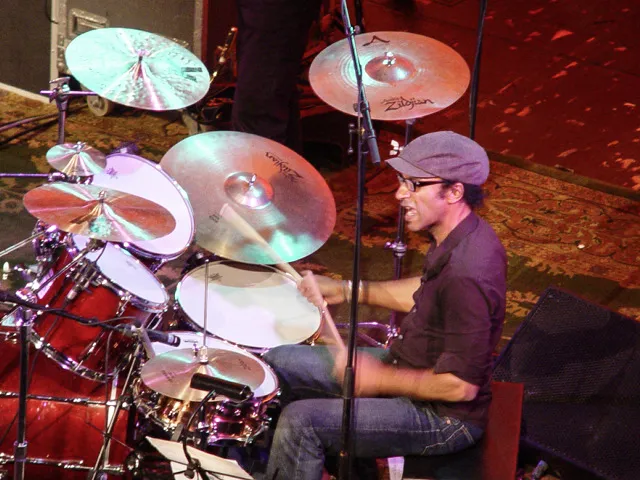
Photo: Hreinn Gudlaugsson, CC BY-SA 4.0, via Wikimedia Commons
Rules Were Made to Be Distorted
Every DAW tutorial tells you the same stuff. Keep your levels below zero. Don't clip the master. Use reference tracks. Pan things tastefully. And yeah, that advice has its place — but it also produces music that sounds exactly like every other well-behaved, technically correct track drowning in a Spotify playlist.
The producers making genuinely interesting music right now? A lot of them are doing the opposite. They're clipping on purpose. They're sampling their own mistakes. They're running synths through guitar pedals and recording the room noise and calling it texture. And it works.
Here are 10 of those techniques — explained, contextualized, and ready for you to try tonight.
1. Intentional Saturation and Soft Clipping
Clipping used to be the cardinal sin of audio production. Now it's a stylistic choice. Soft clipping — where you drive a signal just past its limit and let it compress and distort naturally — adds warmth and aggression that clean signals just don't have. Try running your drums through a saturation plugin like Decapitator or even just pushing the gain on a channel strip. Artists in the hyperpop and industrial techno worlds have been doing this for years. The key is soft clipping. Hard clipping sounds like a broken speaker. Soft clipping sounds like attitude.
Try it: Push your snare or kick channel gain until the meter clips slightly, then pull back just a touch. Add a limiter after to catch the peaks. You'll notice it punchier and more present in the mix immediately.
2. Record the Room, Keep the Room
Most producers spend energy eliminating room noise. Try keeping it instead. Recording an acoustic instrument or a vocal and deliberately capturing the room — the ambient hum of a space, the faint sound of traffic outside, the creak of a chair — adds a human, lived-in quality that no reverb plugin can fully fake. Artists like Bon Iver and James Blake have made careers partly on the texture of imperfect recording spaces.
Try it: Record a vocal take or acoustic guitar with your mic further from the source than usual. Keep the room in the mix, low in volume. It adds depth without feeling artificial.
3. Resample Your Own Mistakes
Hit a wrong note? Accidentally triggered the wrong sample? Don't undo. Resample it. Some of the most interesting sonic material comes from accidents that you'd normally throw away. Chop it, pitch it, reverse it, run it through a filter. Producers in the experimental beat scene — think Flying Lotus-adjacent stuff — build entire tracks from recycled mistakes.
Try it: Next session, keep a "mistakes" folder. Don't delete anything weird. Come back to it a week later with fresh ears and see what you can flip.
4. Pitch Your Samples Way Too Far
Time-stretching and pitch-shifting artifacts used to be things producers tried to hide. Now they're aesthetic. Pitching a vocal sample down four or five octaves creates a guttural, almost inhuman texture. Pitching a drum loop up dramatically turns it into something percussive and metallic. The artifacts the algorithm creates become part of the sound. Producers in the UK drill and experimental electronic scenes have weaponized this for years.
Try it: Take any vocal chop and pitch it down 3-5 semitones more than feels comfortable. Adjust the formant separately if your DAW allows. See what happens.
5. Use Guitar Pedals on Everything That Isn't a Guitar
A reverb pedal on a synth bass. A chorus pedal on a drum machine. A fuzz pedal on a piano sample. Guitar pedals were designed for one instrument and they sound genuinely weird on everything else — in the best possible way. The hardware analog circuitry adds a color and unpredictability that software pedal emulations rarely match. Artists like Com Truise and Toro y Moi have used this approach to create sounds that sit in an uncanny, satisfying middle ground between organic and electronic.
Try it: Run your synth output through a cheap overdrive or chorus pedal before it hits your interface. Record what comes out. Even a $30 pedal can transform a sound completely.
6. Lo-Fi Degradation on Purpose
Export a track at a low bit rate — 64kbps MP3, for example — then reimport it and use that as your audio source. The compression artifacts, the smearing of transients, the loss of high-frequency detail — all of that becomes texture. It's the audio equivalent of photocopying a photocopy. Some producers run this process multiple times to get increasingly degraded, gritty versions of their sounds. It's a staple of the vaporwave and lo-fi hip-hop worlds.
Try it: Export a drum loop as a low-quality MP3, reimport it, and layer it under your clean version at low volume. The grime underneath adds depth.
7. Automate Everything Slightly Randomly
Static sounds are boring. Instead of drawing in precise automation curves, use random or sample-and-hold LFOs to add subtle, unpredictable movement to your parameters — filter cutoff, reverb size, panning, even volume. The randomness mimics the natural imperfection of live performance. It keeps listeners' ears engaged without them consciously knowing why.
Try it: Assign a slow random LFO to your reverb's wet/dry knob. Keep the range small — like 5-10%. Hit play and notice how the track suddenly breathes.
8. Reverse Reverb as a Textural Layer
This one's been around, but producers still sleep on it. Take a sound, add a long reverb, bounce it, reverse the whole thing, and use the reversed reverb tail as a pre-sound that leads into the original hit. It creates a swell that feels cinematic and strange. Used sparingly, it transforms transitions and drops.
Try it: Apply this to a snare or a vocal hit. Use the reversed reverb as a riser into the drop. It'll feel massive.
9. Detune Unison Synths More Than Recommended
Most tutorials tell you to keep unison detune subtle — a few cents at most. Ignore that. Crank the detune on a unison synth past the "tasteful" point and you get something that sounds like it's falling apart in the best way. Wide, chorusing, almost seasick. Artists in the dreamy electronic and shoegaze-adjacent worlds use this to create walls of sound that feel overwhelming and enveloping.
Try it: Load a simple saw wave synth with 4-voice unison. Slowly push the detune knob past where it feels comfortable. Stop when it sounds like two drunk people trying to play the same note.
10. Record Silence, Then Use It
This sounds like a joke. It isn't. Recording 30 seconds of "silence" in your recording space captures the actual noise floor of your environment — the hum of your computer fan, the buzz of your lights, the faint ambient tone of the room. This noise can be used as a subtle bed underneath a track to add a sense of physical space. It makes digital productions feel like they exist somewhere real.
Try it: Hit record with nothing playing. Let it run for 30 seconds. Import that clip, pitch it around, layer it low under a quiet section of your track. See if it adds the feeling of a physical space.
The Point Isn't Chaos — It's Intention
None of these techniques work if you're just throwing stuff at the wall. The producers who pull this off successfully are using "wrong" methods with clear creative intent. They know what they're going for, and they're willing to break conventions to get there.
That's the whole ethos here at Ant Boy Music — original sounds, raw energy, no filter. These tricks aren't shortcuts. They're tools for building something that sounds like you instead of sounding like the tutorial you watched last week.
Get weird with it.